One of the most vivid and exciting projects I remember from my childhood was "growing butterflies" with my father.
When our 3-year-old daughter began asking questions about science, the changing seasons, and metamorphosis, I knew it was time to conjure up some caterpillars of our own.
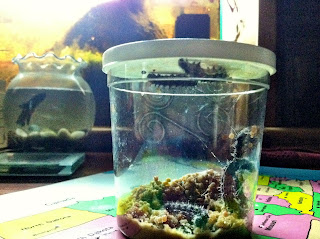 |
| Caterpillars making their way to the top of the cup to form chrysalides |
After some research, we ordered the
Insect Lore Butterfly Garden so we could reuse the butterfly enclosure in the future to replicate the activity. I'm glad we went this route, because this experiment has been so thrilling that we are already talking about getting more caterpillars!
We placed our order online and, within a week, our caterpillar larvae arrived in a small, self contained cup with food on the bottom.
We immediately set up an observation table to watch the little caterpillars grow. They were so tiny at first, but my daughter promptly named all five (Green Bean, Dola, Stola, Jay and Falayla) and watched their every move over the next several days.
Our lil' friends grew so quickly, and soon then began to climb up to the top of the cup to hang upside down.
 |
| The strongest claimed the top of the cup while the weaker two were forced to make their chrysalides on the bottom of the cup. |
We had two caterpillars hanging upside down, and three more working their way up. My daughter and I examined the hanging wigglers carefully and then headed off for a quick outdoor romp that couldn't have lasted more than 20 minutes.
When we came back inside, we peered in to see if the others had madeit to the top and found that the two who had already been hanging had formed complete chrysalides! We couldn't believe it! How did that happen so quickly?!?
We made EVERY effort to catch the others make this unbelievably speedy transformation but it evaded us every time. It must happen over the course of only a few minutes! This is definitely something we're going to catch when we replicate this experiment. Watch closely!!!
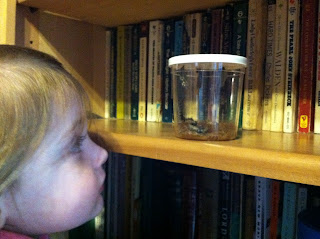 |
Our daughter, watching her caterpillars. Once the chrysalides were formed, we moved the cup to an out of reach shelf so as not to disturb growth.
The next phenomenon occurred when one of the caterpillars (who had yet to form a chrysalis) attempted to claim a hanging territory too close to one of the already formed chrysalides.
We read, in our research prior to conducting this experiment, that as a defense mechanism, the chrysalides might shake a bit to ward off predators. Boy, DO they!
The already formed chrysalis started to quiver as the caterpillar invaded its space, and it began a definite shake as the caterpillar crept even closer. But suddenly, as if it sensed every move, the chrysalis began to VIOLENTLY flip around inside the cup. We thought it would absolutely knock itself off the top, because it was flinging itself around so intensely that it was literally hitting the lid of the cup on each side as it waved itself back and forth.
It was amazing to witness! That chrysalis knocked the intruding caterpillar onto the bottom of the cup! Knowing defeat, that caterpillar was forced to form its chrysalis on the floor of the cup to avoid being attacked again.
|
 |
| To transfer to enclosure, simply remove paper from top of cup and pin to side of mesh wall. We also pinned the tape we used to help the disadvantaged chrysalides form properly. |
Once all the caterpillars had formed chrysalides, it was time to move them from the cup in which they arrived into their butterfly enclosure. Because the three chrysalides that claimed the top of the cup were clearly not sharing their space, the two caterpillars that were not "the fittest" made their chrysalides on the bottom and needed extra human assistance. If left to form on the bottom, their wings would not develop properly, another disadvantage for these poor buggers. We did a bit more research and ended up using tape to place around the nub at the top of the chrysalides. Then we stuck a pin through the tape and hung these two separate from the other.
Next, we waited. It took about 10 days for emergence. It was fun to check our chrysalides each day, but we made sure to keep the enclosure out of reach so that they wouldn't be disturbed by our daughter's curious observations.
After the 10 day period ended, we noticed that one of the chrysalides began darkening at the bottom. The darkening progressed upward over the next 12-15 hours, indicative of close emergence time. We watched obsessively throughout this stage in hopes to catch a butterfly during the actual emergence. I even woke up to check on the darkened chrysalides at night!
 |
| Notice the chrysalis on the upper left side darkening from the bottom. This butterfly emerged about 12 hours after this photo was taken. |
We prepared food before the first butterfly emerged so that we wouldn't have to open the top to disturb them during this delicate phase. First, we placed two, folded, paper towels on the bottom of the enclosure. We added fresh tulips, mixed two tablespoons of sugar in water and then used a pipette to drip the liquid on top of the petals and onto the towels.
 |
| Preparing food for butterflies |
I read that, if you do not have the means to acquire flowers, you can crumple up tissue paper and soak it in the sugar/water mixture to sustain the butterflies.
 |
| Enclosure ready for emergences |
During this time period, we kept the enclosure near us wherever we went. The emergence happens in a matter of seconds, so we kept close watch.
 |
| Once the top of the chrysalis turns black, emergence is extremely close. |
We were devastated that, when we stepped away for a brief moment, we MISSED the emergence of the first butterfly. We returned to find our newborn directly adjacent to its broken chrysalis.
In the photo above, you can see the first drop of meconium, which spread out all over the mesh moments later. As each butterfly emerges and drops this meconium, it begins to look a little gory in there.
 |
| Here you can see the spread of the meconium from the 1st butterfly as the 2nd emerges. |
The enclosure will get progressively more unsightly as each butterfly releases its meconium.
Unfortunately, unless you remove the butterflies, clean the enclosure with soap and water, and then return them to the inside, you will have to live with the red splotches until the release. These icky stains were the ONLY downside to the entire experience- a small price to pay for an amazing learning process.
We were so fortunate to witness the entire emergences of two butterflies—completely mind-boggling.
The chrysalis begins to shake a bit, and then the bottom splits open as the butterfly begins to writhe.
 |
| Gorgeous creatures |
In a matter of seconds, antennae pop out and uncurl and wings begin to stretch out of the shell. After a few more seconds, the wings begin to open and softly flutter.
The thrill of witnessing this process is beyond description. Our whole family was entranced. Simply miraculous!
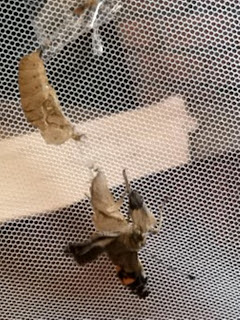 |
| Actual emergence |
As our butterflies matured, we kept them next to our family table for observation. Our daughter embraced every moment of raising these butterflies and even fed them herself every other day. She simply used the pipette to add fresh sugar water to the flowers or orange slices we kept in the bottom of the enclosure.
The butterflies were absolutely beautiful. They fluttered around inside their enclosure from time to time and were fascinating to observe. We particularly enjoyed watching them eat. They inject their proboscis into the sugar water mixture or directly into the orange slices we provided, wonderful to watch and discuss.
Our butterflies lived in captivity until we decided it was time to release them into the wild.
The instructions indicate that they shouldn't be released until the weather is over 55 degrees, so we held out as long as we could to ensure their survival.
As you can see from the photograph below, our daughters were, at first, very upset about having to say goodbye to their winged friends. In an attempt to quell the sadness, I told my eldest to wear her butterfly t-shirt to send them out into the world.
We brought our enclosure outside and unzipped the lid to encourage them to find their way to freedom.
Once the butterflies have been released, they do tend to stay in the general vicinity. We got such a kick out of spotting them
hanging around the area where they had been released.
Once we finished freeing the butterflies, we washed out our enclosure with soap and hot water. The meconium stains came right out with some mild scrubbing, so we can and WILL absolutely reuse our butterfly home.
What an amazing project this was!
Our family and any visitors who stumbled upon our caterpillars/butterflies all found their life cycle fascinating.
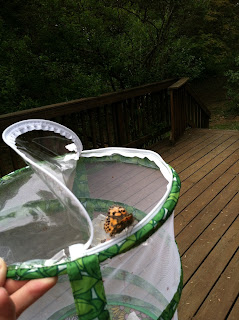 |
| Happy trails, friends! |
This process lasted through the entire month of April in our home, and each day proved to be a new and rewarding learning experience for our family and friends.
The scientific elements of survival and metamorphosis were ever present and memorable through this process. I was most impressed with how my daughter gained responsibility, in feeding and caring for her butterflies, and how she grasped the concept of loving something and letting it go.
At first, it was hard for her to understand that we were freeing these butterflies instead of robbing them from her care, but she definitely began to appreciate and embrace the action once she saw her butterflies in the wild. Something clicked, and she felt incredibly proud of herself for completing the process in the end.
We will absolutely purchase more caterpillars. I would like to repeat this experiment in warmer weather so that we can release the butterflies earlier in their life cycle to determine if they will return to our home if we leave orange slices or watermelon out for them.
Raising these caterpillars and observing their metamorphosis into butterflies was an incredibly symbolic and inspiring process that I feel confident ANY family will appreciate.
Because I remember my own experience with this project as a child myself, I couldn't wait to replicate that wonder with my own children and the rewards were even greater this time around.
Ahhhh, the cycle of life. Simply amazing!
Check out the follow up post on our 2nd batch
here.
XOXO From My Hearth to Yours
P.S. "Like" From My Hearth to Yours on Facebook here for news, updates and reader tips.


